
November 2025 Market Update
✨ October Market Story: What the Numbers Mean for Your Next Step in Ada County
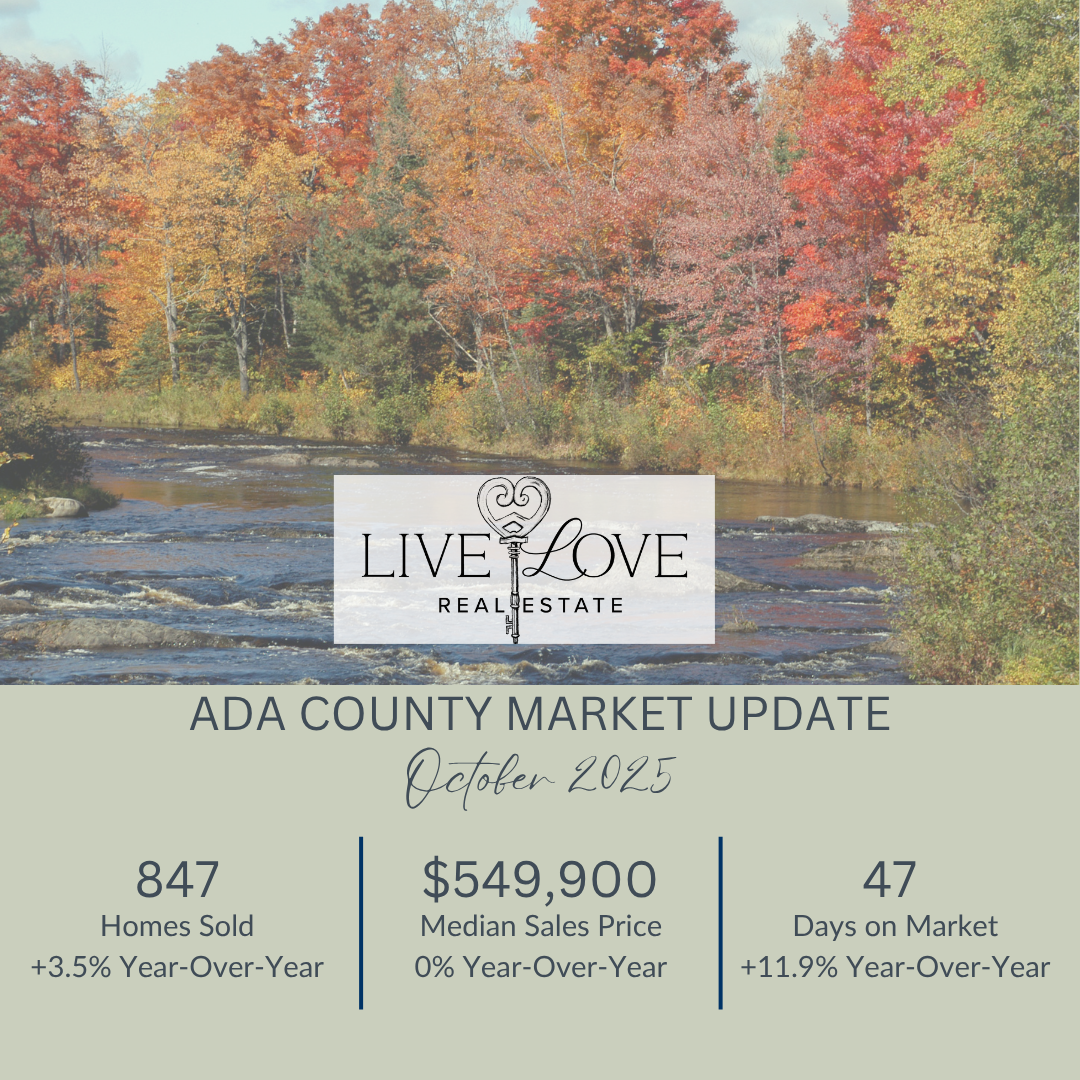
Every fall in the Treasure Valley, the light changes first. Trees dull from bright green to amber, the air sharpens in the morning, and the rush of summer gives way to a slower, more deliberate pace. This year, the housing market is moving the same way—not stopping, not crashing—just shifting into a calmer, more considered season.
October’s market data from Boise Regional Realtors tells a clear story: stability with more choice.
The median sales price in Ada County landed at $549,900, almost exactly where it was a year ago. In a year marked by changing interest rates and affordability worries, that flat price line matters. It tells us that, despite the noise, home values here have not unraveled. We’re not in a runaway market anymore, but we’re also not in a free fall. Prices are holding.
Where we are seeing movement is in the number of homes on the market and how quickly they’re being purchased.
Compared to last fall, inventory is up by roughly a quarter. That’s not a small change. It means buyers have more options than they’ve had in several years—more neighborhoods to compare, more floor plans to choose from, more chances to find a home that actually fits their life instead of just “the only thing available.” The days of everything selling in three days with ten offers are, for now, behind us, and that’s a healthy correction.
Even with more homes available, buyers didn’t retreat. Closed sales rose year-over-year, which tells us people are still acting on their plans: relocating for work, downsizing, upsizing, buying their first place. There is real demand underneath these numbers. At the same time, from September to October, pending sales declined, which is what we typically see as we move into the holiday season. Families pause for school routines, travel, and holiday budgets. The market doesn’t shut down—but the pace becomes more humane.
Looking a little closer, the picture gets more nuanced.
Resale homes have seen a small year-over-year price uptick, and they’re taking longer to sell. That extra time on the market isn’t a sign of collapse; it’s a sign of negotiation making its way back into the process. Buyers are comparing, asking harder questions, and making sure the price and condition line up. Sellers can still do very well—but “testing the market” with an unrealistic number is far riskier than it was a couple of years ago.
New construction is the most active part of the market. Builders are carrying inventory, and they’re motivated to move it. That shows up in more available new homes and in pricing or incentives that are often more flexible than what individual sellers can offer. For many move-up buyers—those who already own a home but need something different—new construction is becoming a serious, and sometimes surprisingly attainable, option. It’s one of the few paths where you can trade up in features and layout while still having room to negotiate.
So what does all of this actually mean for you—not in theory, but in real life?
It means we’re in a more balanced, more thoughtful market than we’ve seen in years.
If you’re a homeowner worried about your equity, the data so far is reassuring: values have held steady through a year of higher rates and higher inventory.
If your current home no longer fits your life—too small, too large, too far from what you care about—this environment gives you something we haven’t had in a while: options plus time. You can sell into a market that still recognizes the value of your home, and you can shop in a market where you’re not forced into snap decisions in a single weekend.
The more helpful question isn’t, “Is it the perfect time to buy or sell?” That question usually leads to paralysis. A better question is:
Is your current home still supporting the life you want to live over the next few years?
Or is it quietly asking for a change—more space for the people you love, less maintenance so you can travel, a different neighborhood that fits the way you actually live now?
If you’re standing in that in-between space—curious, hopeful, and maybe a little unsure—you don’t have to figure it out alone.
Let’s look at the numbers that apply to your specific neighborhood, your equity, and your goals. Let’s tell the truth about what’s possible in this market for you—not in headlines, but in real options.
And then, together, we can map out a next step that feels both financially wise and deeply aligned with the life you’re building.